

What do the stickers on my car seat mean?
Car seats often look like they’ve been tagged by a confused graphic designer. They’re covered in bright orange labels, cryptic diagrams, and QR codes. While they might not match your car's interior, they aren't just for show - they are your "quick-start guide" to keeping your child safe.

The Orange Approval Label: The "Birth Certificate"
The most important label is the orange sticker. This is the seat's proof that it has passed rigorous testing. In the UK, you’ll usually see one of two regulations:
• ECE R44/04: An older standard where seats are grouped by the child’s weight (e.g., Group 0+, 1, 2).
• ECE R129 (i-Size): The newest standard. These seats are categorised by the child’s height and weight (cm and kg).
What the "E" circle means: You’ll see a capital ‘E’ followed by a number (like E1 for Germany or E11 for the UK). This simply tells you which country performed the safety testing. It’s valid across Europe and the UK regardless of the number.
Is i-Size the same as R129?
Almost! Think of R129 as the "parent" regulation and i-Size as its most common "child." If your seat is i-Size, it means it is designed to fit into "i-Size ready" car seating positions using ISOFIX.

The Airbag Warning: Non-Negotiable
You’ll see a bright label - often on the side of the headrest or the sun canopy - showing a red "prohibited" circle over a seat and an airbag.
The Rule: Never, ever place a rear-facing car seat in a passenger seat with an active front airbag. The force of an inflating airbag against the back of a car seat can be fatal.

Installation Guides: Follow the Colours
Most seats have stickers on the shell to show you how to fit them. To make things easier, they are often colour-coded:
• Blue/Green: Indicates the path for the seatbelt when rear-facing. Blue is for R44 seats and Green is for R129 seats.
• Red: Usually indicates the path for forward-facing installation.
• "2x Click": On ISOFIX seats, you’ll often see a symbol reminding you to listen for the clicks and check the green indicators on the base.

Hidden Info: Serial Numbers and Dates
If you look under the seat or behind the fabric, you’ll find a white sticker with a Manufacturing Date and a Serial Number.
This is vital for:
• Registering your warranty.
• Checking for recalls.
• Checking the seat's "expiry": Car seat plastic degrades over time. Most manufacturers recommend replacing an infant carrier after 5-7 years.

"For Use in Aircraft"
Some seats feature a TÜV Rheinland sticker. This means the seat is certified for use on a plane. If you see this, you can usually take the seat into the cabin rather than checking it into the hold (though always check with your airline first).
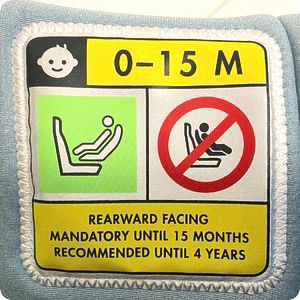
The ‘0-15 M’ Label
This specific label is a crucial reminder of the latest safety standards. It highlights that for R129 seats, keeping your child rear-facing is mandatory until at least 15 months by law. While the seat may be able to be turned forward-facing after this milestone, it is much safer to stay rear-facing for longer.
In fact, this particular label suggests a recommendation to rear-face until at least 4 years old, as this provides significantly better protection for a child’s developing head, neck, and spine in the event of a collision. Many modern seats are now designed to accommodate this extended rear-facing position. Always double-check your specific seat's manual, as the maximum height and weight limits for rear-facing vary between models.
Why these labels matter
Labels are there to prevent "user error" - the biggest risk to car seat safety. They are especially helpful if:
• A grandparent or childminder is using the seat for the first time.
• You’ve lost the paper manual (though most new seats have a QR code on the side you can scan to get a digital copy instantly!).
• You need to check if your child has outgrown the seat's height or weight limit.
FAQs
Can I remove the stickers?
No. Please leave them on! Not only do they contain life-saving info, but if you ever need to contact the manufacturer or check the seat’s history, you’ll need the numbers on those labels.
Are all labels the same?
The "look" varies by brand, but the content is legal. Every seat sold in the UK must have the orange approval label and the airbag warning.


