

The Ultimate Newborn Car Seat Guide
Bringing your newborn home is one of the biggest moments in your lives - and for many parents, the car seat is one of the first “wait…am I doing this right?” experiences.
This guide covers the essentials in a clear, calm way, so you can focus on your baby, not second-guessing every strap and buckle.
Choosing the right seat
For newborns, you’re typically looking at:
Infant carriers (Group 0+ / from birth)
Rear-facing multistage seats
Both can be safe options when used correctly.
Infant carriers are:
Portable
Often lasting to around 12-18 months
Compatible with prams
Rear-facing multistage seats:
Stay in the car
Last longer
The most important thing is not the “type” of seat - it’s that it:
Fits your baby well
Fits your car
Is used correctly every time
Why rear-facing matters
All newborns must travel rear-facing, and this should continue for as long as possible, ideally to 125cm / 36kg.
Rear-facing seats support:
The head
The neck
The spine
In a crash, the forces are spread across the whole body, rather than being concentrated on the neck.
Getting the fit right for a newborn
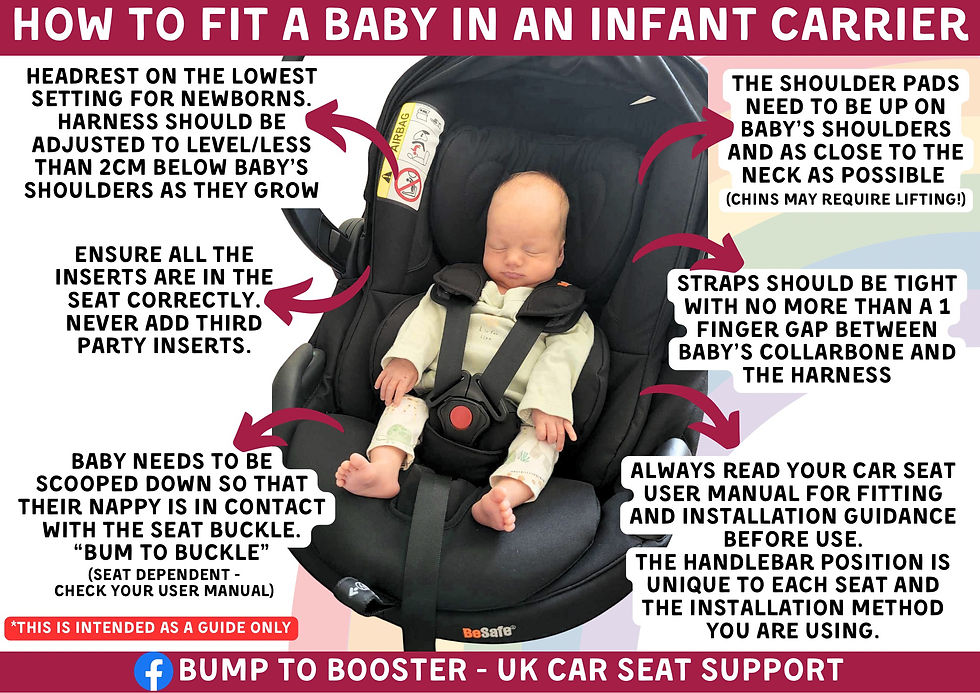
Newborns are small, curled, and still developing - so getting a good fit is key.
Look for:
Harness straps at or just below shoulder height
A snug harness at the collarbone (you shouldn’t be able to pinch it)
A natural, slightly curled position
Many seats come with newborn inserts, which help improve fit. These should only be removed when your baby outgrows them, as per the manual.
What recline should I use?
Newborns need a more reclined position to help keep their airway open.
However, the exact recline:
Depends on the seat
May vary depending on installation method
May offer a better, more supportive fit in a certain position
Always check your manual and use the recline setting specified for your baby’s stage.
Harnessing your newborn safely
The harness should:
Sit flat, with no twists
Be snug against the collarbone (a gap at the tummy is normal)
Avoid:
Bulky clothing (like coats or snowsuits)
Anything added that didn’t come with the seat
A good check is the pinch test - if you can pinch the harness, it’s too loose.
Travel tips for newborns
Newborns shouldn’t stay in a car seat for extended periods.
General guidance is to:
Take regular breaks (30-45 mins max at a time)
Avoid long periods in the seat outside of travel - time limits still apply when using the seat outside of the car
Also:
Keep an eye on temperature (cars can warm up quickly)
Remove hats once in the car seat
Don’t place the seat on raised surfaces when not in the car
FAQs
How long can my newborn stay in a car seat?
It’s recommended to take regular breaks every 30-45 minutes and avoid extended periods in the seat, particularly for very young babies.
Should my baby look scrunched up?
A slightly curled position is normal for newborns. What you’re looking for is a clear airway and a well-supported body.
Do I need an ISOFIX base?
No - many infant carriers can be safely installed with a seatbelt. ISOFIX bases can make installation easier but aren’t essential or safer.
💛 A final note
No one gets this perfect straight away.
Car seat safety is something you learn over time, and it’s completely normal to check, question, and adjust as you go.
If you’re ever unsure, asking for help is always the right thing to do.


