
What are anti-rotation and anti-rebound features in car seats?
When choosing a car seat, you might see terms like support leg, top tether, lower tethers, or rebound bar. It can feel like a lot of jargon, but each of these features has a very specific job - controlling how a car seat moves in a crash.
Understanding what they do (and why they matter) can make car seat safety feel a lot more straightforward.
How does a car seat move in a crash?
In a collision, a car seat doesn’t just move forwards. It can:
Rotate forwards
Move back again (rebound)
Twist or rotate sideways
These movements are part of normal crash dynamics, but managing them helps reduce the forces placed on a child.
Anti-forward-rotation: support legs and top tethers
Forward rotation is the main movement in a frontal collision - the seat pivots towards the front of the car.
Anti-forward-rotation features are designed to limit this.
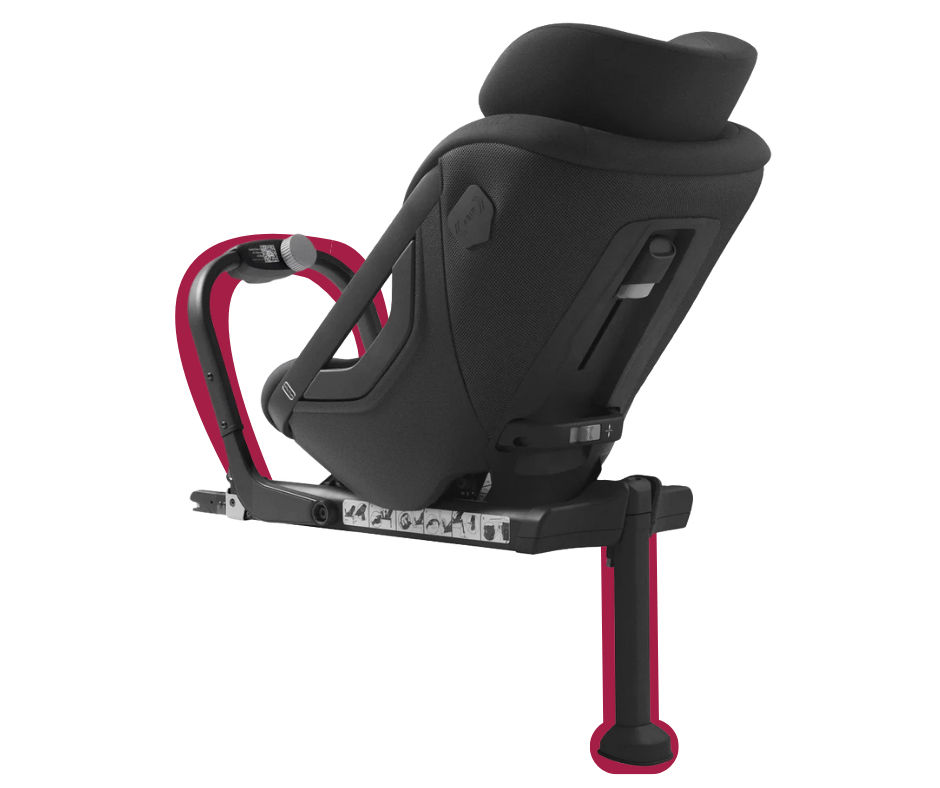
Support legs
A support leg is a metal pole that extends from the car seat base down to the vehicle floor.
It helps to:
Reduce forward rotation
Stabilise the seat
Absorb crash forces
They’re most commonly found on rear-facing seats and ISOFIX bases for infant carriers.
Top tethers
A top tether is a strap that connects the top of the car seat to an anchor point in the vehicle.
It helps to:
Limit how far the seat can move forward
Reduce head excursion in a crash
Keep the seat more controlled
Top tethers are most often used with forward-facing harnessed seats (not high backed boosters).

Anti-rebound: what happens after the initial impact
After the seat moves forward, it will often move back towards the vehicle seat. This is called rebound.
Rebound management helps control this secondary movement.
Rebound bars
A rebound bar sits between the car seat and the vehicle seat back.
It helps to:
Limit backward movement
Keep the seat more stable after the initial impact
These are commonly used on rear-facing ISOFIX seats.
Seat shell design (built-in rebound management)
Some seats manage rebound through their design rather than a separate bar.
Seats like the Graco SlimFit R129 and Joie Stages require specific recline positions when rear-facing. In these cases, the shell of the seat interacts with the vehicle seat to help control rebound.
Infant carrier handle position (built-in rebound management)
On infant carriers, the carry handle also plays an important role in managing rebound.
When positioned correctly, the handle can act in a similar way to a rebound bar by helping to control how the seat moves back towards the vehicle seat after the initial impact.
However, this is not the same for every seat:
Some require the handle to be upright
Some require it to be fully forward at baby’s feet
Some allow multiple approved positions
The correct position can also vary depending on how the seat is installed (for example, seatbelt vs ISOFIX base).
Because of this, it’s really important to:
Check your car seat manual
Follow the specific instructions for your model
Using the wrong handle position may affect how the seat performs in a crash.
Side-rotation and rebound control: lower tethers
Lower tethers are used on some extended rear-facing seats.
They attach to fixed points in the vehicle, usually on the front seat rails.
They help to:
Reduce side-to-side movement
Assist with rebound control
Keep the seat more stable overall

Do all seats use the same system?
No - and that’s completely normal.
Different seats manage crash forces in different ways, using:
Support legs
Top tethers
Lower tethers
Rebound bars
Seat shell design
Sometimes a combination of these is used.
The most important thing is always:
Correct installation
Following the manufacturer’s instructions
FAQs
Do I need all of these features on one seat?
No - seats are designed to meet safety standards using specific combinations. More features doesn’t automatically mean a seat is safer.
Is a support leg better than a top tether?
Not necessarily. They do similar jobs in different ways. The best option is the one that is compatible with your car and used correctly.
Can I add tethers or rebound bars to my seat?
No - only use the features that are built into and approved for your specific car seat.


